AI Cooking Statistics: What the Research Shows
Compiled by Alex Fahey, founder of Chop it. Last updated 16 August 2026. Every figure below links to the organisation that published it, with the date we checked it. Nothing on this page is our own estimate.
Definition. AI cooking covers the use of artificial intelligence tools, most commonly large language models such as ChatGPT, for food tasks at home: generating and adapting recipes, planning meals for a week, building shopping lists, and deciding what to cook from available ingredients.
This page exists because most statistics quoted about AI and cooking are unsourced or invented. These are the numbers we could trace to a named publisher, quoted exactly, with what they do and do not show.
Adoption of AI food tools
Consumer research platform Attest surveyed UK and US consumers on AI in food (Attest, updated 24 June 2026; checked 5 August 2026):
| Measure | Figure |
|---|---|
| Consumers who have used AI-powered tools for food-related activities | 63.8% |
| UK consumers who have used AI food tools | 66.8% |
| US consumers who have used AI food tools | 60.8% |
| 18 to 24 year olds who have used AI food tools | 74% |
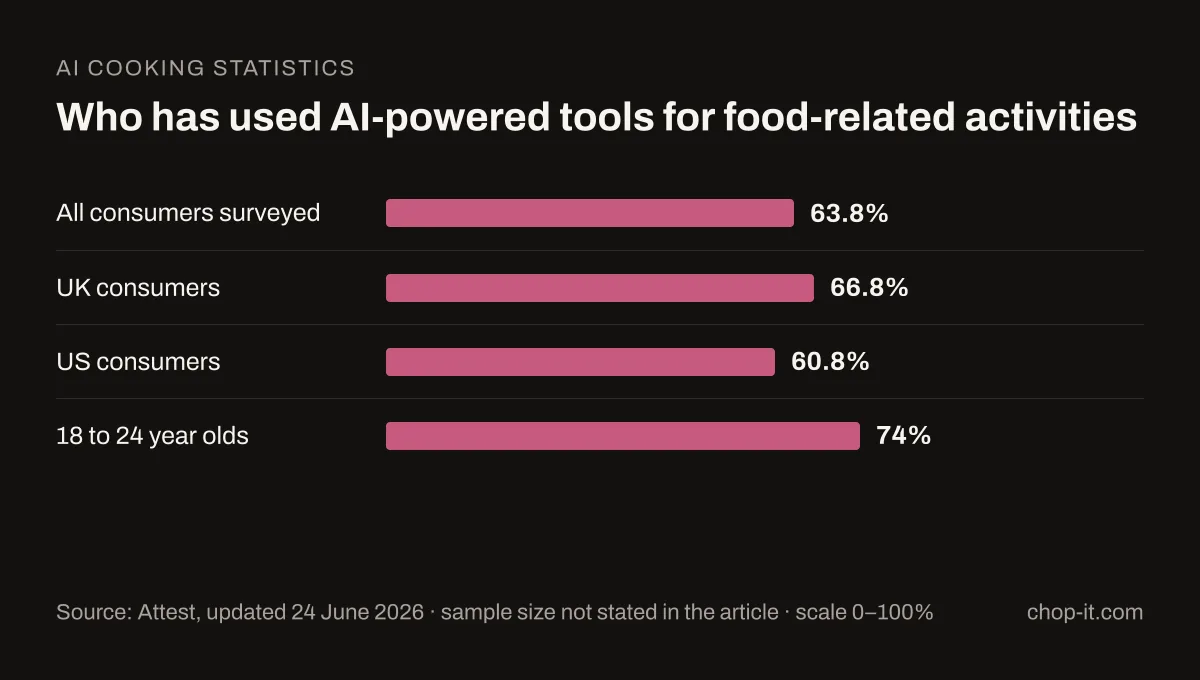
UK adoption runs ahead of the US, and the youngest adults are the heaviest users. Attest does not publish the sample size in the article, worth knowing before you re-quote these figures.
What people are comfortable letting AI do
The same Attest research separates comfort by task, and the gap between tasks is the most useful finding on this page:
| Task | Comfortable (UK) | Comfortable (US) |
|---|---|---|
| AI recipe recommendations | 75.9% | 71.2% |
| Automated online grocery shopping | 49.1% | 48.7% |
Three quarters of UK respondents would take a recipe from an AI. Barely half would let one shop for them. Comfort tracks how reversible the task is: a bad recipe suggestion costs nothing, a wrong automated shop costs money. Anyone building or evaluating AI food tools should expect adoption to follow that gradient.
On intent to try tools in future: 69.3% said they were likely to try AI recipe recommendations, 58.9% smart grocery shopping, and 58.5% personalised meal planning.
The top concern was data privacy, named by 45.8% of UK respondents and 47.7% in the US.
The habits AI cooking tools land into
YouGov's research on UK cooking habits gives the baseline these tools arrive into (YouGov; checked 5 August 2026):
- 19% of Britons say they almost always cook using basic ingredients, 23% cook from scratch most days and 21% a few times a week. Cooking from scratch remains the dominant UK habit.
- 15% say they hardly ever or never cook from scratch.
- 61% have never used a recipe box of pre-portioned ingredients, and 71% have never subscribed to a recipe box service.
The meal-kit figures matter for anyone comparing AI planning tools with kits: most UK households have never bought the incumbent alternative. The realistic comparison for an AI meal planner is not HelloFresh but a supermarket shop with no plan at all. We compare the kits' per-portion costs here.
Food waste, the problem planning attacks
WRAP, the UK's waste-reduction body, publishes the most cited household food waste figures (WRAP; checked 5 August 2026):
- An average UK household of four wastes food worth about £1,000 a year, roughly £86 a month.
- UK homes throw away about 6 million tonnes of food a year, of which 4.4 million tonnes could have been eaten, valued at £17 billion.
- The average person wastes the equivalent of three meals a week.
- Household food waste generates around 16 million tonnes of greenhouse gas emissions.
Whether AI planning reduces that number for a given household is not yet established by independent research, and we do not claim it is. What the WRAP figures establish is the size of the target. Our guide on what AI can and cannot do about food waste is careful about that boundary.
What is not yet measured
Gaps in the public research, stated plainly so this page does not imply more than exists:
- No independent study we can find measures whether AI meal planning reduces household food waste or grocery spend in practice.
- Attest measured comfort and adoption, not sustained use. Nobody has published retention data for AI cooking tools.
- The YouGov and Attest samples are separate surveys and cannot be combined into a single claim about the same people.
When credible research fills these gaps, this page will be updated and the date at the top will move.
Provenance
Everything above, in one table. Where a publisher does not state a field, the cell says so rather than estimating.
| Statistic | Publisher | Published | Geography | Sample size | Source |
|---|---|---|---|---|---|
| 63.8% used AI food tools (66.8% UK, 60.8% US, 74% of 18 to 24s) | Attest | Updated 24 June 2026 | UK and US | Not stated in article | Attest |
| 75.9% UK comfortable with AI recipe recommendations; 49.1% with automated shopping | Attest | Updated 24 June 2026 | UK and US | Not stated in article | Attest |
| 63% cook from scratch most days or more; 61% never used a recipe box | YouGov | Not stated in article | Great Britain | Not stated in article | YouGov |
| £1,000 wasted per household of four; 4.4m tonnes edible, £17bn | WRAP | Not stated on page | UK | National waste estimates, not a survey | WRAP |
All sources checked on 5 August 2026.
Citing this page
Quote the underlying source rather than us where you can: Attest for adoption and comfort, YouGov for UK cooking habits, WRAP for food waste. If you cite this compilation, it is maintained at chop-it.com/research/ai-cooking-statistics and the update date at the top reflects the last check of every figure.
Sources: Attest, "AI in the kitchen" (updated 24 June 2026); YouGov, UK cooking from scratch and meal kits; WRAP household food waste. All checked 5 August 2026.
Frequently asked questions
How many people use AI for cooking?
Attest research updated in June 2026 found 63.8% of consumers had used AI-powered tools for food-related activities, rising to 66.8% in the UK and 74% among 18 to 24 year olds.
Do people trust AI recipe recommendations?
More than most AI food tasks. In the same Attest research 75.9% of UK respondents said they would be comfortable with AI recipe recommendations, against 49.1% for automated grocery shopping. Data privacy was the top concern, named by 45.8% in the UK.