Why Meal Kits Are Losing the Joy of Cooking: Frive and the Race to Convenience

Meal kits remove the planning, shopping and measuring around dinner, but they can also stop people building their own recipe repertoire and kitchen habits. The growth of prepared-meal services such as Frive suggests that when convenience is the only goal, the logical end point is removing the cooking too. Chop it takes the opposite approach: remove the admin, keep the cooking.
Contents
Meal kits are winning the wrong race.
Frive is not really a meal-kit company. It delivers prepared meals. That is exactly why its growth tells us something useful about the wider category.
The Financial Times reported in June 2026 that Frive generated £50 million in revenue in 2025, served 30,000 households a week and had delivered more than 25 million meals. It forecast £70 million revenue for 2026.
At the same time, traditional meal kits are putting more emphasis on speed. The Times reported in March 2026 that HelloFresh orders for 15-minute meals were up 30% year on year and almost five times higher than in 2022. HelloFresh has also expanded its ready-to-eat Factor brand in Europe.
There is an obvious direction of travel.
Fewer ingredients. Fewer steps. Less preparation. Less cooking. Less thinking.
And eventually: why cook at all?
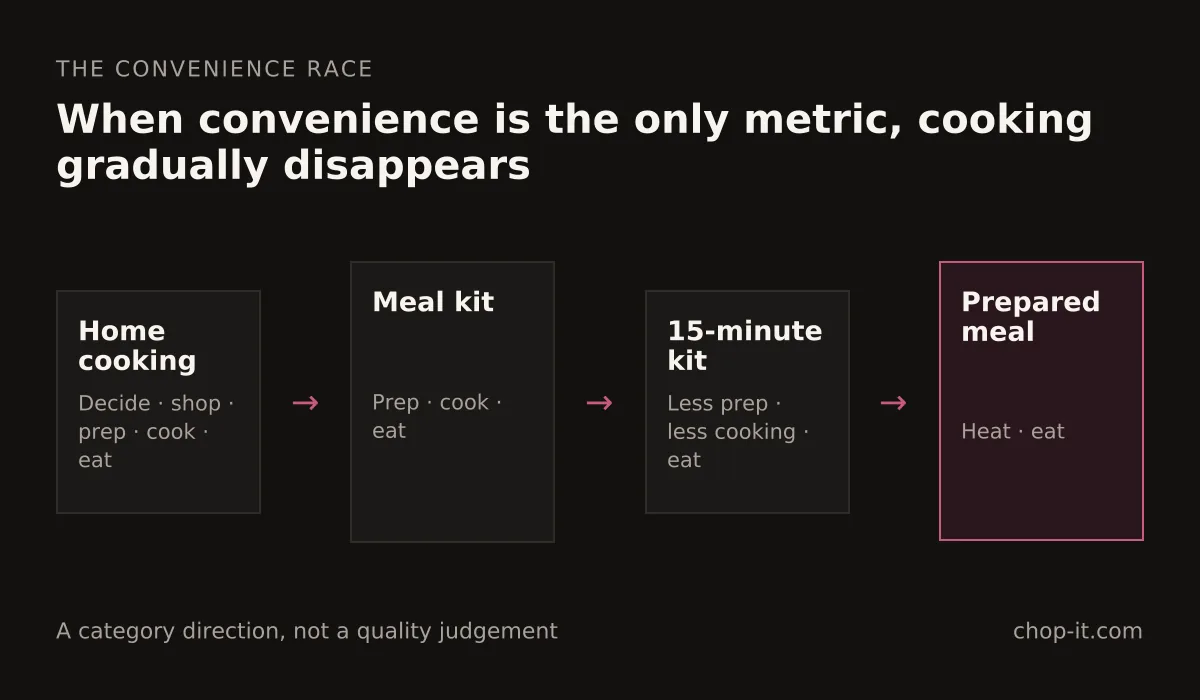
The graphic is not a judgement on any one service. It is the category logic in one line: when convenience is the only measure of progress, cooking gradually disappears.
Why meal kits can make cooking feel harder over time
I am exactly the person meal kits were invented for.
I enjoy food. I am a good home cook. I have a busy job, a family and very little interest in spending Sunday afternoon creating a spreadsheet about what everyone is going to eat for the next seven days.
So meal kits initially felt brilliant.
Someone else had decided what was for dinner. The ingredients arrived. Everything was portioned. There was nothing to remember.
Then, after a few months, I got bored and moved to another service. A few months later I moved again. And again.
After about a year, something quite strange had happened.
I had not stopped liking food. I had forgotten how to feed myself.
Not literally, obviously. But I had lost the habits that made me a good home cook in the first place.
I was not saving recipes I loved. I was not building a repertoire of meals. I was not thinking about what ingredients I normally kept in the house. I was not looking in the fridge and thinking, “I could make something with that.”
Dinner had become an assembly task.
Open the bag. Follow the card. Eat it. Repeat.
After a while, even perfectly decent meals started to feel a bit like prison food to me. Not because the food was bad, but because it was prescribed.
This is dinner tonight. This is dinner tomorrow. Here are the ingredients. Here are the instructions. See you again next week.
The joy of cooking had slowly been replaced by the efficiency of completing dinner.
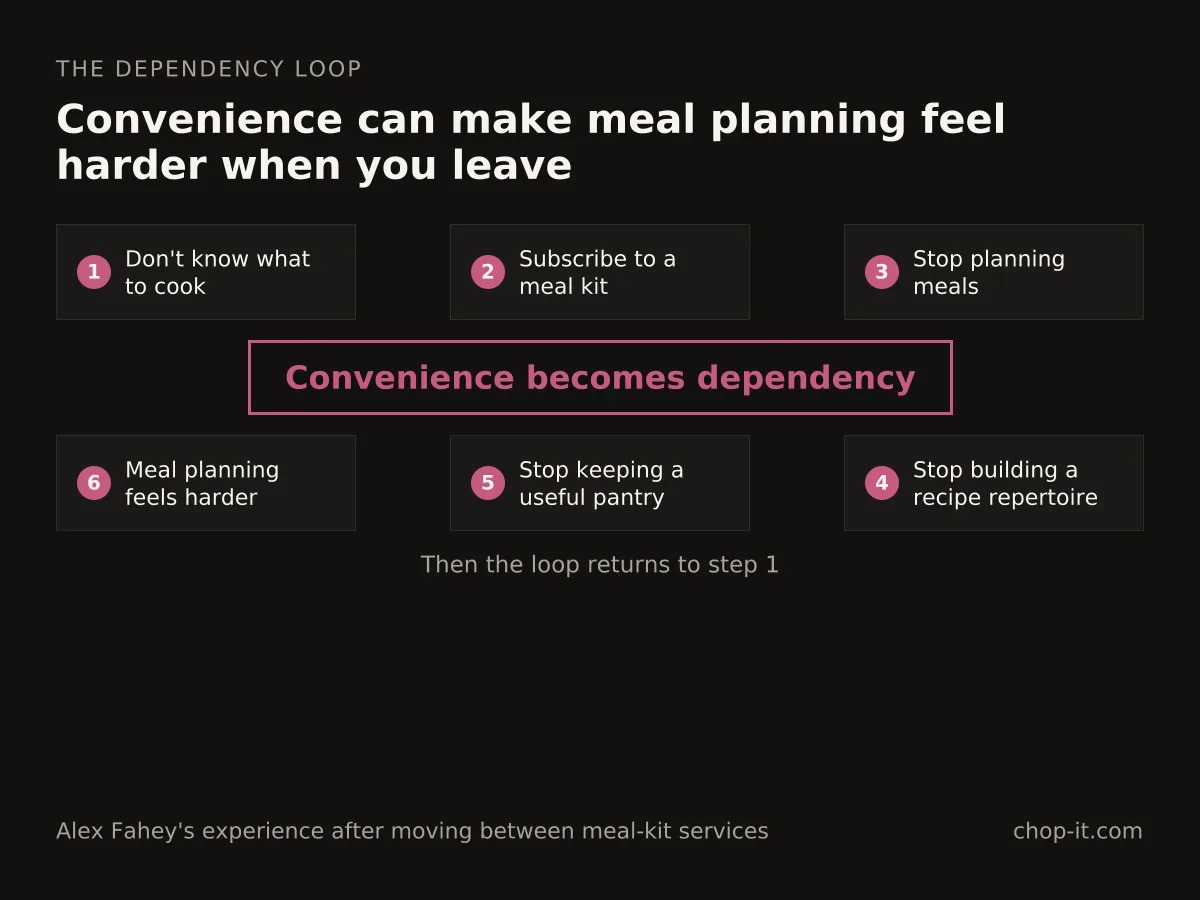
This was my experience, not a universal verdict. Plenty of people use meal kits happily for years. But the loop explains why changing provider every few months never solved my problem. I was outsourcing the habit I needed to rebuild.
Meal planning is part of cooking, not just admin
Meal planning looks like administration. Some of it is. But some of it is also part of cooking.
Remembering that brilliant pasta you made six months ago is part of cooking. Knowing you have half a bag of spinach in the fridge is part of cooking. Deciding that you ate badly all weekend and want fish and vegetables tonight is part of cooking. Changing your mind because it is suddenly sunny outside is part of cooking.
Having ten reliable meals that everyone in your family likes is part of cooking too.
Meal kits solve the administrative problem by replacing that entire system with their own. That works brilliantly until you leave. Then suddenly you are standing in a supermarket thinking: what did I used to buy?
There is another problem. You still have to go shopping.
Meal kits solve some dinners. They do not necessarily solve breakfast, lunch, fruit, milk, snacks, washing-up liquid, toothpaste, nappies or the hundred other things a household needs.
Instead of replacing the weekly shop, they can create a second food system alongside it: your normal groceries, plus a large refrigerated box containing four dinners.
Convenient starts to become surprisingly complicated. If you want the practical alternative, this is the weekly meal-planning system I now use.
Why Frive is the logical conclusion of the convenience race
This is why I find Frive's growth interesting.
It is not evidence that people have stopped caring about food. It is evidence of what happens when the main problem a category is trying to solve becomes time.
If I am already choosing from somebody else's weekly menu, receiving exactly the ingredients they specify and following exactly their instructions, there is a perfectly reasonable question to ask: why am I doing the cooking bit?
Frive answers it. You are not. The meal arrives made.
That is an entirely legitimate product and clearly one that many households want. It also exposes the direction in which the market has been moving.
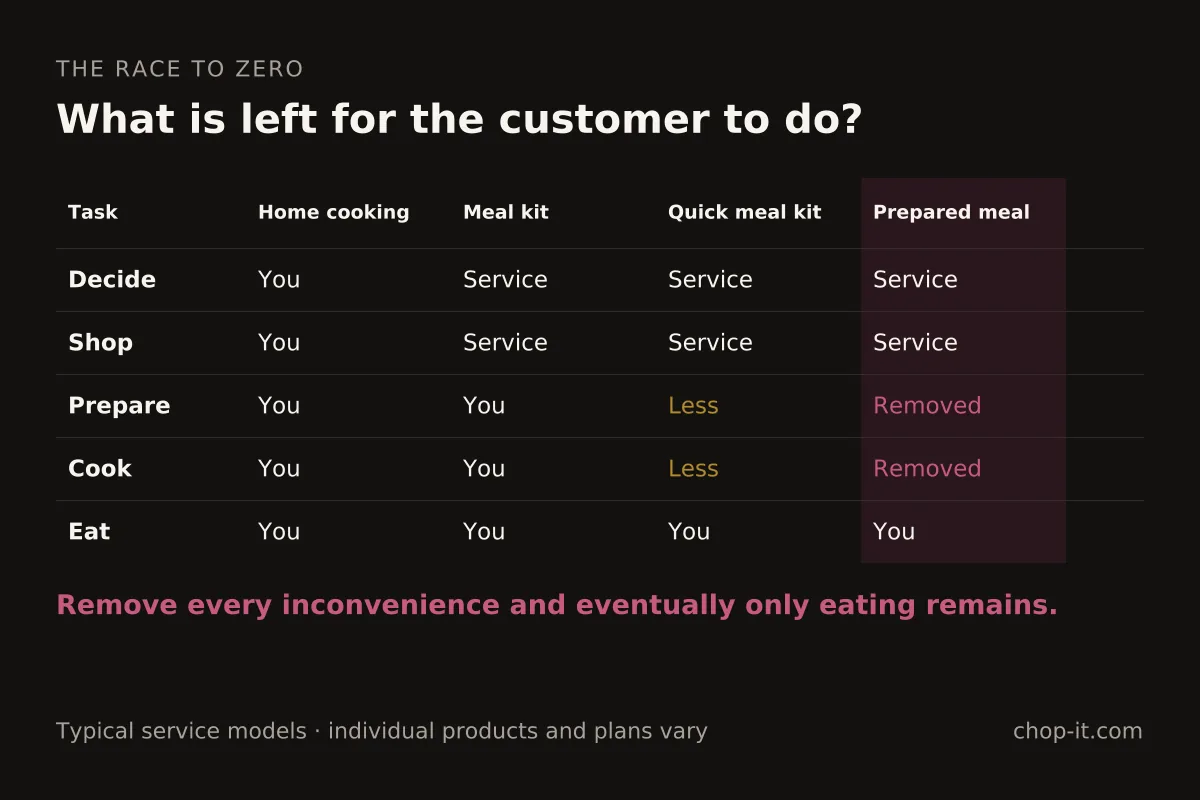
Traditional home cooking asks you to decide, shop, prepare, cook and eat. A meal kit usually removes deciding and most shopping. Faster kits reduce preparation and cooking. A prepared-meal service leaves the eating.
If every inconvenience is removed, eventually the only thing left is eating.
There has to be something between doing all the work yourself and outsourcing dinner completely.
That is the gap I built Chop it to fill.
The missing middle: remove the admin, keep the cooking
Chop it started from a different premise.
I did not want technology to decide what I was allowed to cook. I wanted technology to do the boring work around cooking.
Those are very different things.
I should be able to find a recipe anywhere and keep it. I should be able to build my own collection rather than live inside somebody else's catalogue. If I have ten minutes on Sunday, I should be able to look through useful dinner ideas and rapidly swap the ones I do not fancy.
If I want a healthy reset this week, the system should adapt. If I want comfort food, it should adapt. If I open the fridge and need to use chicken, spinach and half a tub of crème fraîche, I should be able to start there.
And if I change my mind on Wednesday, nothing should break.
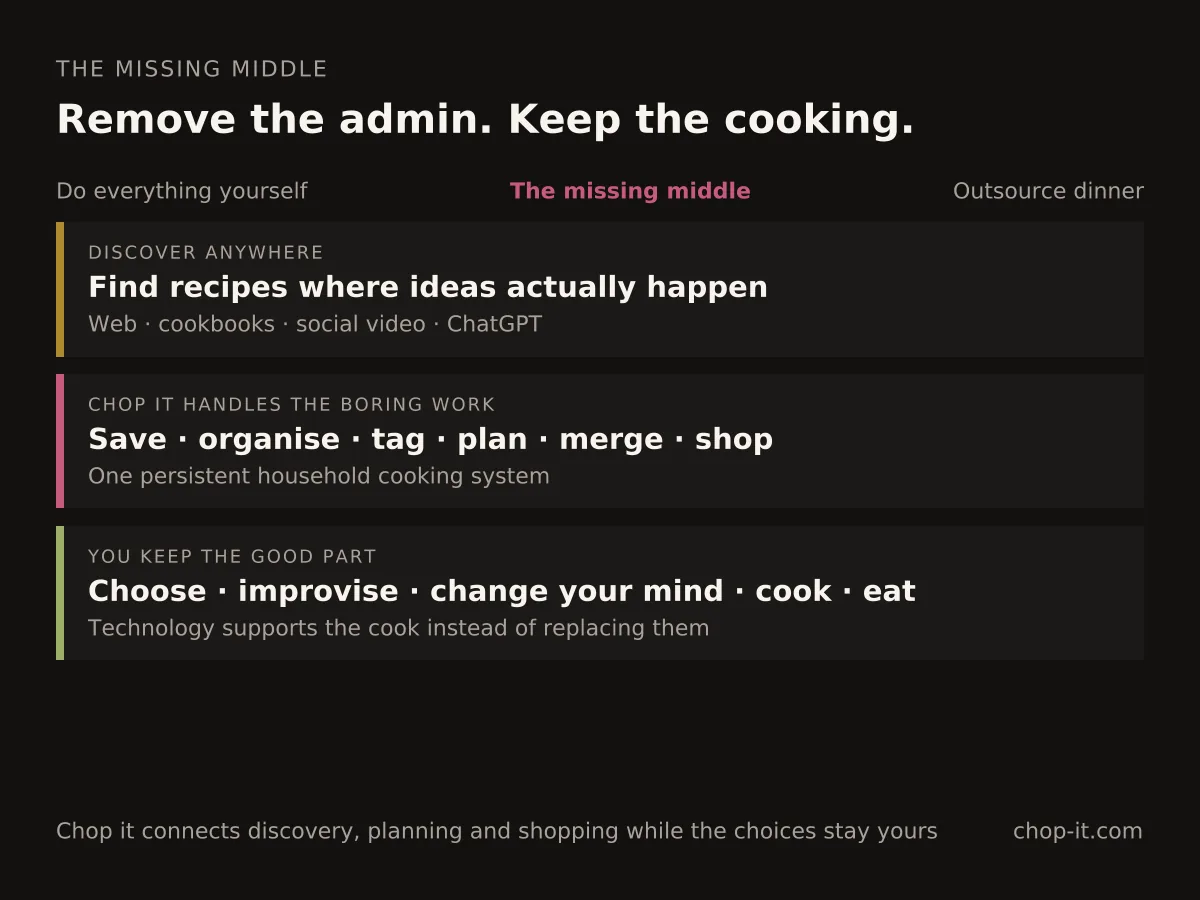
That is the missing middle:
- Discover anywhere: websites, cookbooks, social video and ChatGPT.
- Let Chop it handle the boring work: save, organise, tag, plan, merge and shop.
- Keep the good part: choose, improvise, change your mind, cook and eat.
The meal planning apps I compared for 2026 take very different approaches to this problem. The important distinction is whether the plan belongs to the service or stays useful as part of your own cooking system.
What AI should do in the kitchen
There is a lot of deeply boring work involved in maintaining a genuinely useful personal cooking system.
Recipes need organising. Ingredients need cleaning up. Tags need sorting. Serving sizes need making sense of. A pantry needs to be easy to maintain. A library needs to stay usable as it grows.
None of that makes you a better cook. It is administration, so let the machine do it.
The same applies to planning. Sometimes I want to browse my recipes and put a week together visually. Other times I have 90 seconds and want to say: “Give me five dinners. Two quick ones, something healthy, fish once, and something I can cook properly on Sunday.”
Both should work. The technology should mould itself around how much time I have, not force me through the same workflow every week.
That is also why saving a recipe cannot be the end of the job. The useful system turns it into a plan and then merges the ingredients into one shopping list.
Convenience should not mean surrendering control
I do not think people have suddenly lost their desire to cook. I think modern life has made the organisation surrounding cooking disproportionately difficult.
The answer should not always be to remove cooking. It should be to remove the administration that gets in its way.
That means preserving the things that make home cooking valuable: discovering something new, saving something brilliant, improvising, changing your mind, cooking for people you love and gradually building your own repertoire.
While getting rid of the rubbish surrounding it.
No spreadsheets. No Sunday-night meal-planning headache. No collection of screenshots you can never find again. No wondering what to buy. No being trapped inside somebody else's recipe catalogue. No refrigerated box dictating Wednesday's dinner because you selected it six days ago.
That is why Chop it had to exist.
The future of home cooking should not just be a better subscription box or a better ready meal. It should be technology that makes cooking fit around real life again.
The machine handles the admin. You decide what is for dinner.
Sources and method
- Frive revenue, household and delivery figures: Financial Times, 20 June 2026.
- HelloFresh 15-minute meal demand: The Times, 4 March 2026.
- HelloFresh ready-to-eat expansion: HelloFresh Group press releases.
- The personal account and conclusions are Alex Fahey's experience and opinion. The service comparison describes how much of the dinner process each model normally performs, not every possible plan or product.